
The Yzerplan
Evaluating Steve Yzerman’s tenure as Red Wings GM as Detroit fights to end its playoff drought.

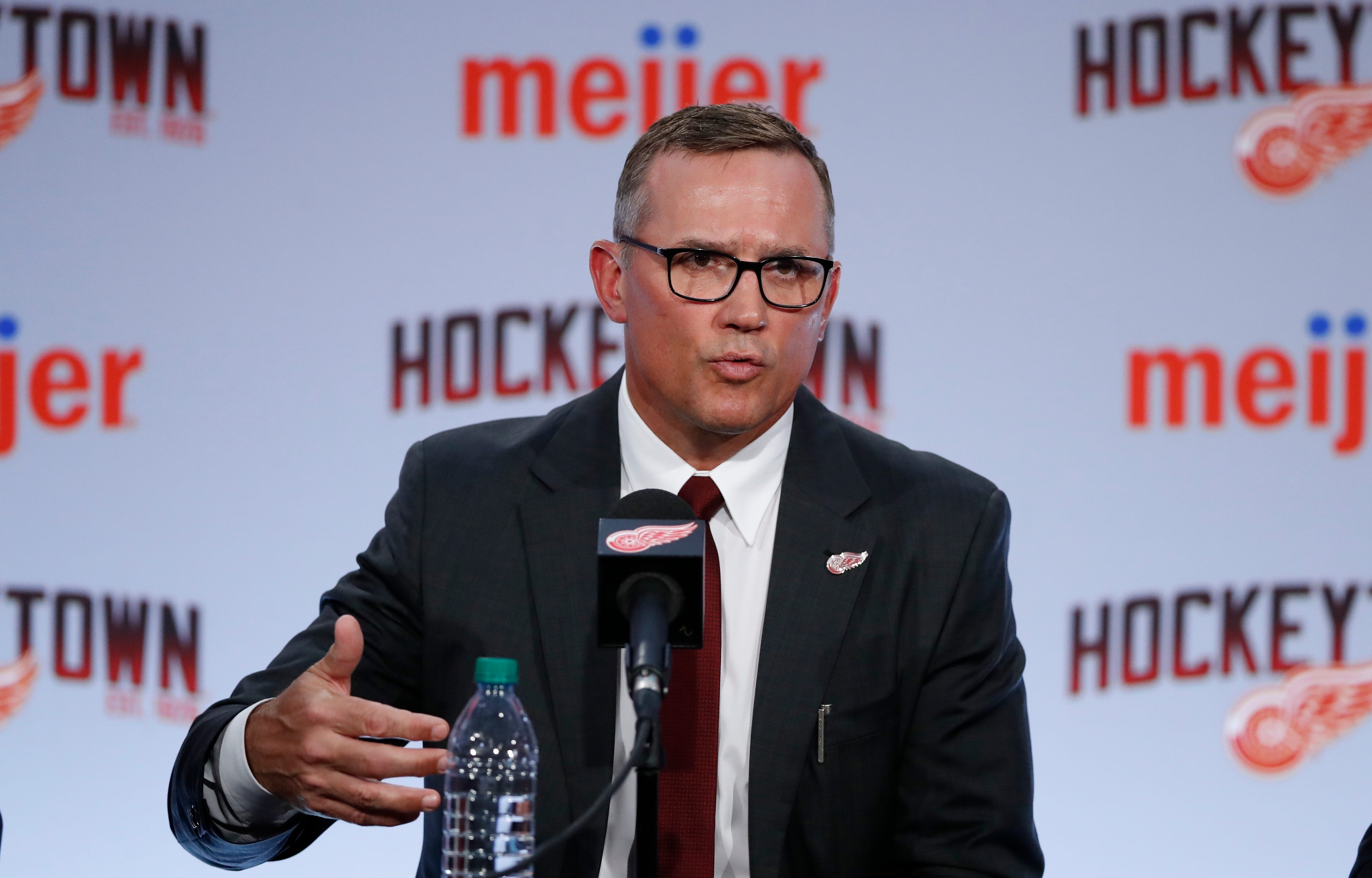
On April 19, 2019, the Detroit Red Wings brought one of the greatest players in franchise history back home to serve as their next general manager. Steve Yzerman was tasked with guiding the organization through a difficult rebuild and returning the team to contention. Excitement around Detroit was understandably high at the time due to his successful work in Tampa Bay, but what has he actually accomplished over his seven years as GM of the Red Wings? And how does his rebuild compare to others that began around the same time?
The Early Years
The 2018–19 Red Wings were a mess. Only four players on their end-of-season roster finished above one win above replacement. Meanwhile, 10 players who played at least 40 games ended the year with a negative WAR. The future outlook was not much better either, as Dobber Prospects had Detroit ranked 22nd in their organizational prospect rankings heading into the 2018–19 season.
Detroit’s pipeline was highlighted by names such as Michael Rasmussen, Tyler Bertuzzi, Evgeny Svechnikov, Dennis Cholowski, Filip Hronek, Filip Zadina, Joe Veleno, and Jonatan Berggren. While this group contained some intriguing players, none were viewed as true blue-chip prospects. Yzerman was taking over a disaster of a roster and had plenty of work to do.
Yzerman’s first draft would see him land a major hit at sixth overall with cornerstone defenseman Moritz Seider. However, the rest of the class was far less impactful. The Red Wings have only gotten a combined 214 NHL games from the other ten players selected in that draft, with Albert Johansson and Elmer Söderblom being the only two to appear in the NHL so far.
The 2019–20 Red Wings were about as bad as expected, finishing the season with a 17–49–5 record, good enough for last place in the NHL. Yzerman did not make many major moves that year aside from selling off Andreas Athanasiou to Edmonton and absorbing Marc Staal’s contract from the Rangers in exchange for three second-round picks.
The Rebuild
Despite falling back three spots in the draft lottery, the Red Wings still managed to land another key piece of their rebuild in Lucas Raymond at fourth overall. Once again, however, the rest of the draft class has not aged particularly well. Detroit has only gotten 29 NHL games from the other 11 players selected in the 2020 draft.
The 2020–21 season was expected to be another throwaway year for the Red Wings. Detroit finished with a 19–27–10 record, good for the sixth-worst record in the league.
This season also marked the first major swing of Yzerman’s tenure, as he traded Anthony Mantha to the Washington Capitals in exchange for Richard Panik, Jakub Vrana, a first-round pick in 2021, and a second-round pick in 2022. At the time, the move was widely praised. Yzerman was able to move off Mantha, who did not fit Detroit’s timeline, while adding a skilled forward in Vrana, along with two valuable draft picks.
In hindsight, the results of the trade did not age as well. Vrana got off to an incredible start in Detroit, recording 11 points in his first 11 games with the team. However, injuries and a stint in the NHL’s Player Assistance Program derailed his time with the Red Wings, eventually leading to his waiver placement and a trade to the St. Louis Blues for a minor leaguer and a seventh-round pick a few years later. The situation with Vrana was in no way Yzerman’s fault. The trade was well executed at the time, but circumstances ultimately did not work out in Detroit’s favour.
The 2021 draft would once again see the Red Wings add a key piece to their blueline with Simon Edvinsson at sixth overall. Detroit also selected goalie prospect Sebastian Cossa, who has had a strong start to his professional career in the AHL, posting a .915 save percentage through his first three full seasons in Grand Rapids. However, once again, the picks after the first round have yet to yield meaningful results for Detroit, with just one NHL game played between the other six players selected in that draft.
The Red Wings would post a 32–40–10 record during the 2021–22 season, finishing 12th in the Eastern Conference while beginning to show signs of a turnaround. This was also the first time we saw Yzerman begin moving assets to acquire more established NHL talent. In two offseason deals, he traded Richard Panik, Jonathan Bernier, a second-round pick, and a third-round pick to acquire Nick Leddy and Alex Nedeljkovic.
The Nedeljkovic trade looked like a good bet at the time. He had just posted a 15.19 GSAx during the 2020–21 season, which ranked fourth in the NHL. However, that performance would prove to be a massive outlier, as he has not recorded a positive GSAx again since.
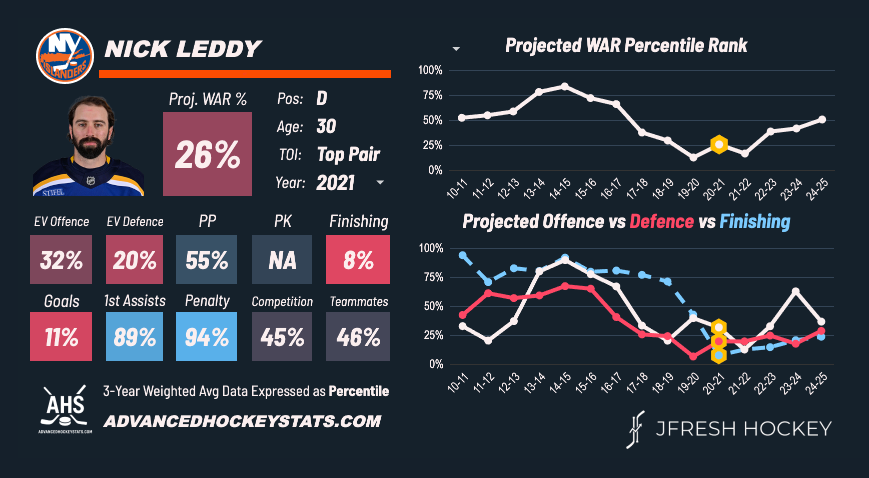
The Nick Leddy deal was a bit more puzzling. His underlying numbers had been trending downward since the 2016–17 season, and he had steadily been losing minutes in New York over the previous few years. He also did not provide much offensive impact from the blueline, which was something Detroit badly needed at the time. Leddy was eventually flipped to the St. Louis Blues at the trade deadline for Oskar Sundqvist, Jake Walman, and a second-round pick. That move ended up being a solid pivot by Yzerman, but it still raises questions about the price Detroit paid to acquire Leddy in the first place.
The Corner?
The 2022 offseason is where I believe Yzerman made his biggest mistakes. The Red Wings improved from a 42.9% points percentage in 2020–21 to 45.1% in 2021–22, but instead of continuing to weaponize his cap space for additional assets, Yzerman chose to get aggressive in free agency.
He first traded a third-round pick to acquire Ville Husso from the St. Louis Blues, once again attempting to solve Detroit’s long-standing issues in goal. While the move itself was questionable, it signalled a shift in approach for the organization.
The real turning point came in free agency. With significant cap space available, Yzerman handed out several large contracts in an effort to accelerate Detroit’s progress toward playoff contention. Below is a chart outlining the five biggest deals signed during that offseason.
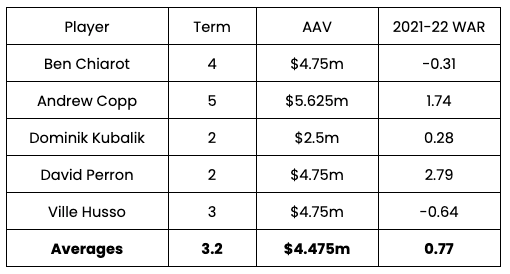
The Perron signing was likely the “safest” bet of the group based on his 2021–22 season, but the overall strategy was overly aggressive for where the Red Wings were in their rebuild. Detroit was still a team that needed to accumulate assets and develop young talent, not one that should have been pushing its chips toward immediate contention. The results of the 2022–23 season seemed to support that concern. Even with the aggressive additions, the Red Wings finished 35–37–10, placing 12th in the Eastern Conference.
During the 2022–23 season, the Red Wings ended up selling off Filip Hronek, Tyler Bertuzzi, and a fourth-round pick in a series of deadline moves that brought back two first-round picks, a second-round pick, and a fourth-round pick. The returns themselves were strong, particularly in the Hronek deal.
However, the decision to move Hronek was somewhat puzzling. He was just 25 years old and still had another year remaining on his contract. While the package Detroit received was good value, Hronek was not necessarily a player the Red Wings needed to move at that stage of the rebuild, especially considering the hole it created at the top of their defensive core.
Yzerman’s 2022 draft followed a similar pattern to the previous ones. Detroit landed a promising player in Marco Kasper at eighth overall, but the rest of the class has yet to produce any meaningful NHL impact. To this point, none of the other eight players selected in that draft have appeared in an NHL game.
The 2023 offseason was another somewhat aggressive one for Yzerman. He traded Dominik Kubalik, Donovan Sebrango, a first-round pick, and a fourth-round pick to Ottawa in exchange for Alex DeBrincat. Yzerman was also active in free agency, signing Justin Holl and J.T. Compher to multi-year deals.
The DeBrincat trade was excellent value for Detroit, but it again signalled that Yzerman believed the rebuild phase was largely over. The free agency signings were much more questionable. Holl and Compher were not bargain under-the-radar finds or players coming off breakout seasons, making the long-term commitments somewhat difficult to justify for a team that was still trying to establish itself.
From this point on, it is difficult to fully judge Detroit’s draft classes since many of the players have not yet had enough time to earn meaningful NHL opportunities. That said, the Red Wings’ top three selections in 2023, Nate Danielson, Axel Sandin-Pellikka, and Trey Augustine, have all looked like promising prospects so far.
The 2023–24 season did show some positive growth for Detroit. The Red Wings finished with a 41–32–9 record and spent much of the year in a playoff position. However, a late-season collapse, including a 3–9–2 record in March, ultimately caused them to fall just short of ending their playoff drought once again.
Today
The 2024 offseason began with Yzerman having to dump a second-round pick to move the contract of Jake Walman, a very solid defenseman, as the consequences of the previous two offseasons finally caught up to the team. Detroit also continued its revolving door in goal by signing Cam Talbot to a two-year deal. In addition, the Red Wings added veteran forwards Vladimir Tarasenko and Patrick Kane.
Detroit would go on to finish the 2024–25 season with a 39–35–8 record, once again missing the playoffs.
The Red Wings remained aggressive the following year. During the 2025 offseason, Detroit acquired John Gibson in hopes that he could finally stabilize the team’s goaltending situation. They also recently moved a first-round pick at the trade deadline to acquire Justin Faulk from the St. Louis Blues.
As things currently stand, Detroit sits three points ahead of a playoff spot with 17 games remaining in the 2025–26 season.
Some of Yzerman’s tenure can be chalked up to bad luck. Betting on players like Jakub Vrana and Alex Nedeljkovic could have easily worked out in his favour, but the consistent overpays in free agency are much harder to justify. At a certain point, those decisions have to be viewed as reckless spending rather than calculated risks.
Drafting is another area where Detroit has struggled. During his time in Tampa Bay, Yzerman built a reputation for finding mid-to-late round steals. Players like Nikita Kucherov (R2), Taylor Raddysh (R2), Radko Gudas (R3), Brayden Point (R3), Anthony Cirelli (R3), Cedric Paquette (R4), Mathieu Joseph (R4), Ross Colton (R4), Nick Perbix (R6), and Ondrej Palat (R7) all developed into solid NHL players, with many playing major roles in Tampa Bay’s back-to-back Stanley Cup championships.
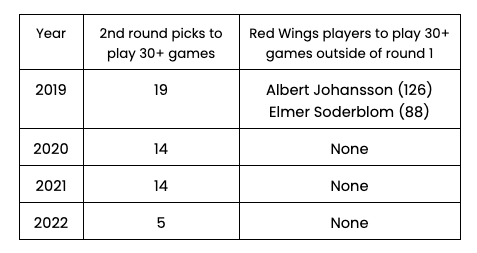
In Detroit, that level of draft success has simply not been there. Second-round pick Albert Johansson and seventh-round pick Emmitt Finnie are currently the only non–first–round selections from the Yzerman era on the Red Wings roster.
This isn’t to say Yzerman has been the worst GM in the league. However, another playoff miss after holding a top-eight spot for much of the season would be a significant blemish on his tenure in Detroit. Ultimately, the biggest challenge for both Red Wings fans and ownership may be separating the results from the name of the man overseeing them.
So I’ll leave you with this question: if everything outlined in this article had been done by a first-time GM that no one had ever heard of, would he still have a job?
All contract info from Puckpedia
All stats from HockeyStats.com
All prospect info from HockeyDB