

Conquering The Storm
How a blogger helped reshape the Hurricanes' identity and built a Stanley Cup champion.

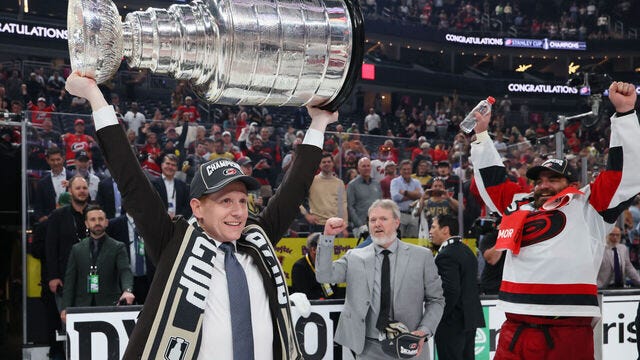
Eric Tulsky is about as far from a traditional hockey executive as you can get. He earned a degree in chemistry and physics from Harvard before completing a PhD in chemistry at the University of California, Berkeley. After spending two years conducting research at the Naval Research Laboratory, Tulsky worked in the nanotechnology industry for a decade, including roles with companies in Silicon Valley. Nothing about that path screams “career in hockey.”
In between trying to build Iron Man, Tulsky, who was primarily a baseball fan, began writing for a Philadelphia Flyers blog. In 2013, he spoke at the Sloan Sports Analytics Conference about the importance of puck possession and why teams should move away from relying on dump-and-chase hockey.
In May 2024, Tulsky was promoted to General Manager of the Carolina Hurricanes. The Hurricanes had already established themselves as one of the NHL’s strongest regular-season teams, but they repeatedly ran into the same problem in the playoffs. Opponents found ways to slow down Carolina’s offence. Tulsky’s challenge was to help the organization evolve, adding a second pitch to an already successful formula using many of the same ideas he had been advocating for more than a decade earlier.
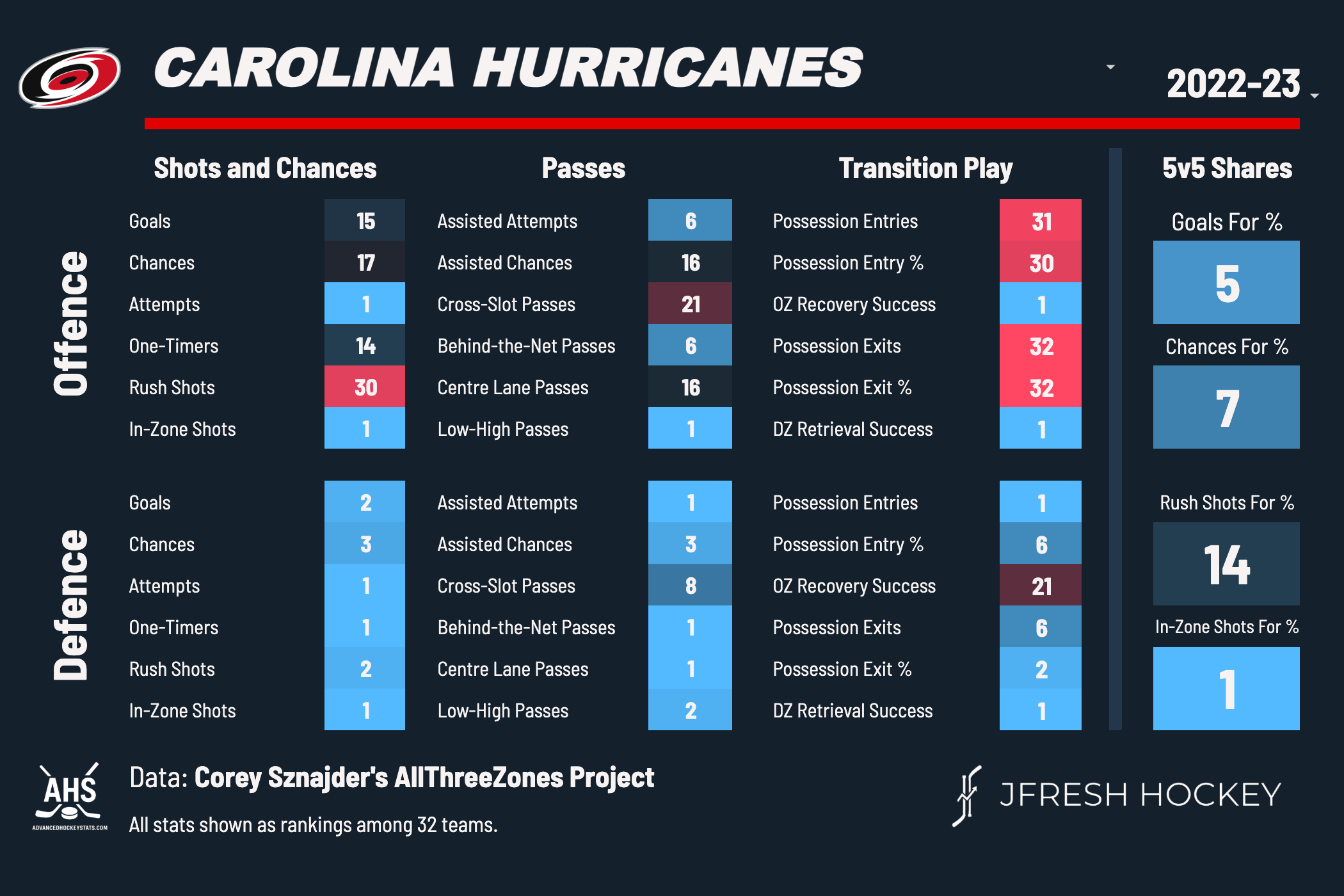
Carolina was a heavy dump-and-chase team, one of the only teams in the modern NHL to find success playing that style. The Hurricanes were 31st in possession entries and 30th in possession entry % in the 2022-23 season. They were also 30th in rush shots.
Tulsky’s first major move as General Manager came on January 24, 2025, when he sent Jack Drury and Martin Necas, among other assets, to the Colorado Avalanche in exchange for Mikko Rantanen and Taylor Hall.
The Rantanen side of the deal has been well documented, but Hall’s inclusion was largely overlooked at the time. By that point in his career, Hall was viewed as a flawed player whose best days were behind him. Most saw him as a capable depth scorer rather than a difference-maker.
What made Hall appealing to Carolina, however, was his ability to create offence off the rush. During the 2025-26 season, Hall ranked in the 79th percentile in rush shots, the 83rd percentile in rush shot assists, and the 85th percentile in overall rush offence. Those are exactly the types of skills the Hurricanes were looking to add as they worked to diversify an attack that had become increasingly reliant on dump-ins and forechecking pressure.
Hall wasn’t the centrepiece of Carolina’s transformation, but he was the perfect complementary piece to help change how the Hurricanes generated offence.
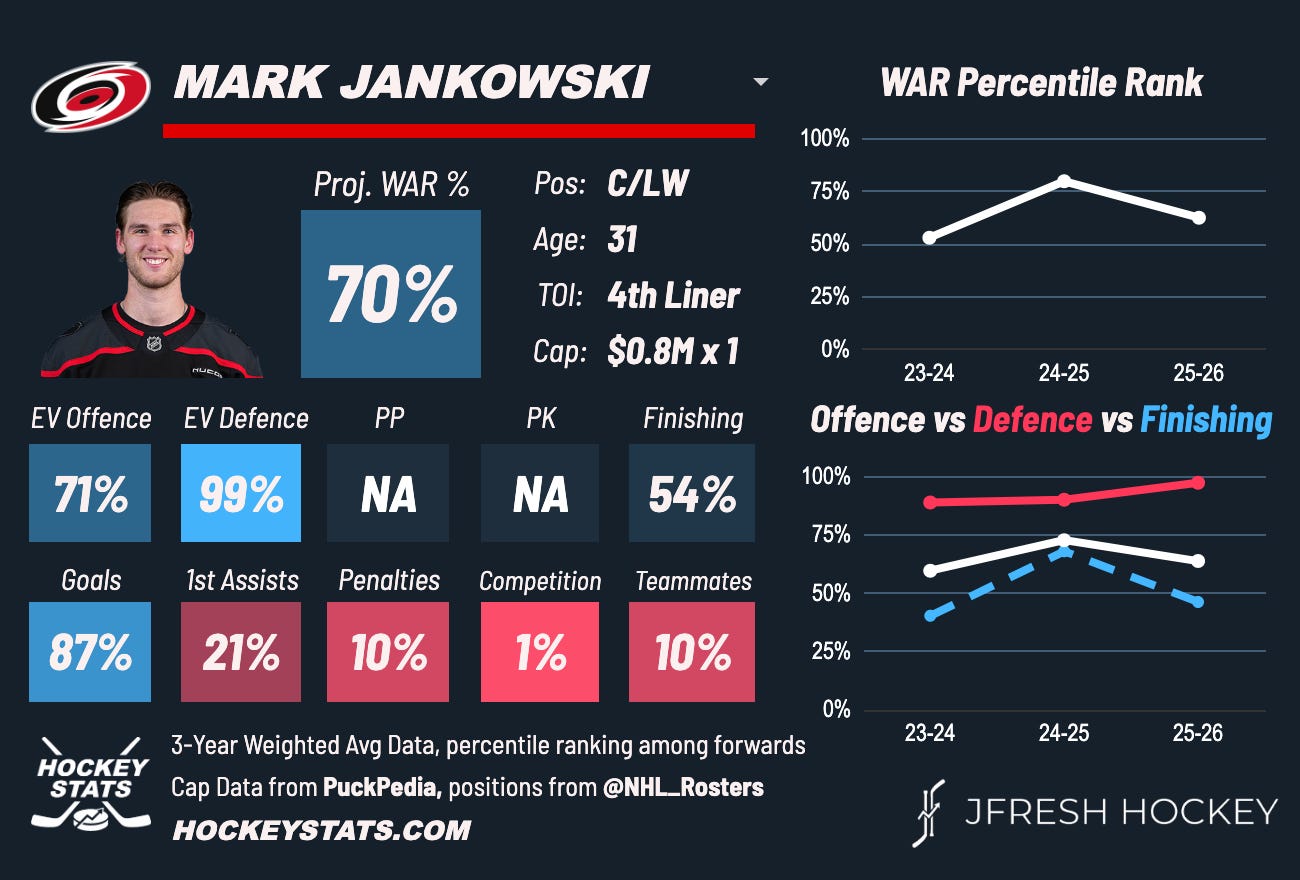
Tulsky continued to add useful depth pieces to the roster, acquiring Mark Jankowski for a fifth-round pick. Jankowski was one of the NHL’s premier shutdown forwards, but what made him particularly valuable was that he could suppress chances without sacrificing puck possession. While many defensive specialists struggle to drive play, Jankowski consistently helped his team control the puck and move it in the right direction.
Finally, Tulsky showed he was willing to pivot when circumstances changed. Less than two months after acquiring Mikko Rantanen, he flipped the pending free agent to the Dallas Stars in exchange for Logan Stankoven, two first-round picks, and two third-round picks.
On paper, Stankoven is not the same calibre of player as Rantanen. Rantanen went on to score 77 points in 64 games with Dallas in 2025-26, while Stankoven finished the season with a more modest 44 points. However, Tulsky was not simply chasing point totals. He was building an identity.
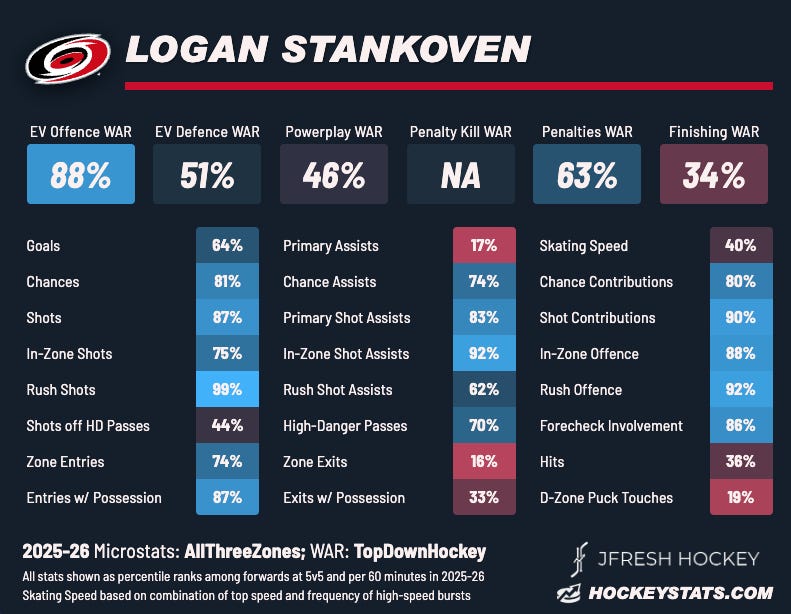
Stankoven is one of the NHL’s most dangerous rush forwards, consistently creating offence through speed, puck carrying, and transition play. While Rantanen may have been the more productive player, Stankoven’s skill set aligned perfectly with the style of hockey Carolina was trying to play. For Tulsky, how a player created offence was just as important as how much offence they produced.
Tulsky also added several key pieces through free agency. He signed William Carrier, a reliable two-way bottom-six forward, Eric Robinson, an undervalued middle-six winger who excelled at generating offence off the rush, and Sean Walker, one of the NHL’s most effective neutral-zone passers.
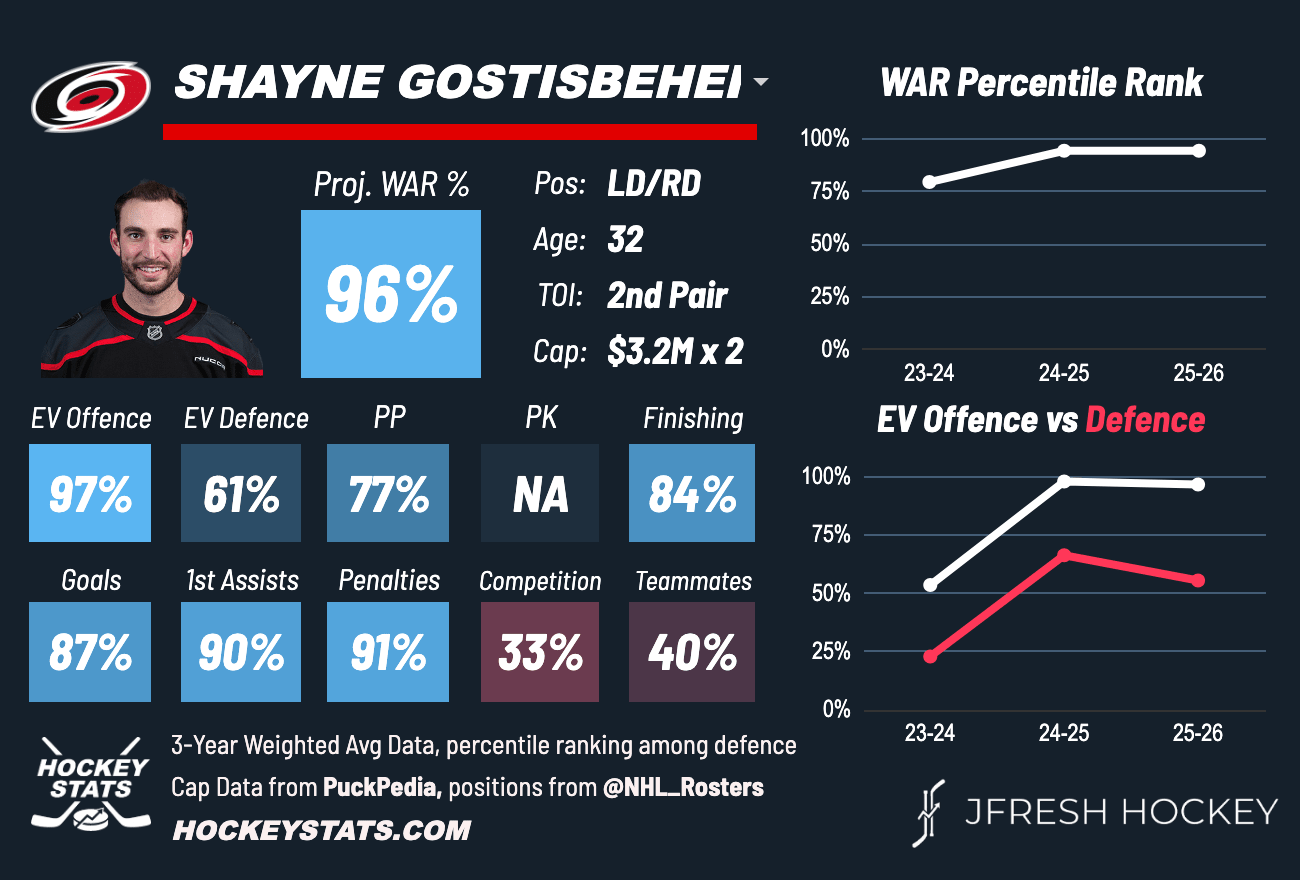
However, the most important addition may have been Shayne Gostisbehere, who deserves a closer look.
The Hurricanes’ blueline is somewhat unique due to the fact that their number one D isn’t their primary offensive driver on the back end. Jaccob Slavin is a fantastic player, but his biggest weakness is his ability to drive the offence. So they needed to find someone who could be that driver.
Enter Shayne Gostisbehere. For years, Gostisbehere had been one of the NHL’s most productive offensive defensemen, but he was often passed around the league because he wasn’t capable of serving as the centrepiece of a blue line.
For Carolina, however, that wasn’t a problem. The Hurricanes didn’t need a number-one defenseman. They needed a second-tier offensive contributor who could drive transition play and create offence from the back end. Gostisbehere was exactly that player.
Moving into the 2025-26 season, there were three key moves made by Tulsky this season. The first being grabbing Brandon Bussi off waivers. Bussi would end up playing 39 regular-season games for the Hurricanes and would win the final three games of the Stanley Cup Final.
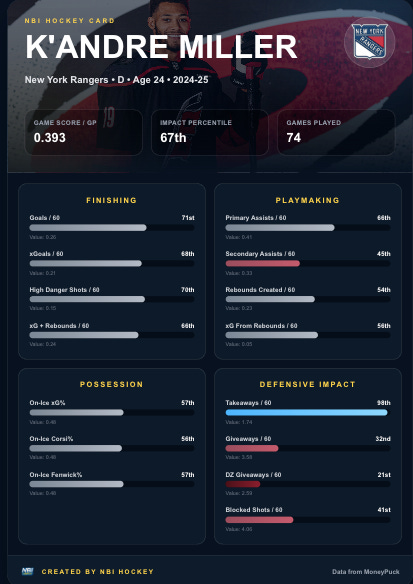
Second, and perhaps most controversially, the Hurricanes acquired K’Andre Miller, a second-pair defenseman who had fallen out of favour with both Rangers fans and management. Miller is far from a perfect player, but much like Taylor Hall, his strengths fit seamlessly into Carolina’s system.
The biggest criticism of Miller’s game has always been his tendency to commit turnovers, particularly in the defensive zone. However, Carolina is uniquely positioned to absorb that weakness. The Hurricanes generate such a high volume of offensive opportunities that the occasional turnover carries less weight than it would on a team that struggles to create chances consistently.
The Hurricanes had reshaped much of their roster, but they still needed a centrepiece. Enter Nikolaj Ehlers, one of the NHL’s premier transition forwards. Long underutilized in Winnipeg, Ehlers was yet another player whose strengths aligned perfectly with Carolina’s evolving identity.
Ehlers quickly became a key driver of the Hurricanes’ new offensive approach. With greater freedom to attack off the rush and through the neutral zone, he posted the best offensive season of his career, reaching the 70-point mark for the first time.
In just two years, the Hurricanes transformed from a high-volume dump-and-chase team that ranked near the bottom of the league in carry-in offence into the NHL’s leader in transition goals and a top-five team in carry-in offence. Defensively, they shifted from a more passive neutral-zone approach to an aggressive man-to-man system that consistently forced mistakes and created turnovers.
Tulsky may have only been in charge for two seasons, but his fingerprints are all over this team. Few general managers have managed to alter an organization’s identity so dramatically in such a short period of time. More importantly, Carolina’s success does not appear to be a one-year phenomenon. The Hurricanes enter the offseason with significant cap space, a deep prospect pool, and plenty of draft capital. Their Stanley Cup victory may not be the end of their window; it could be the beginning of it.